
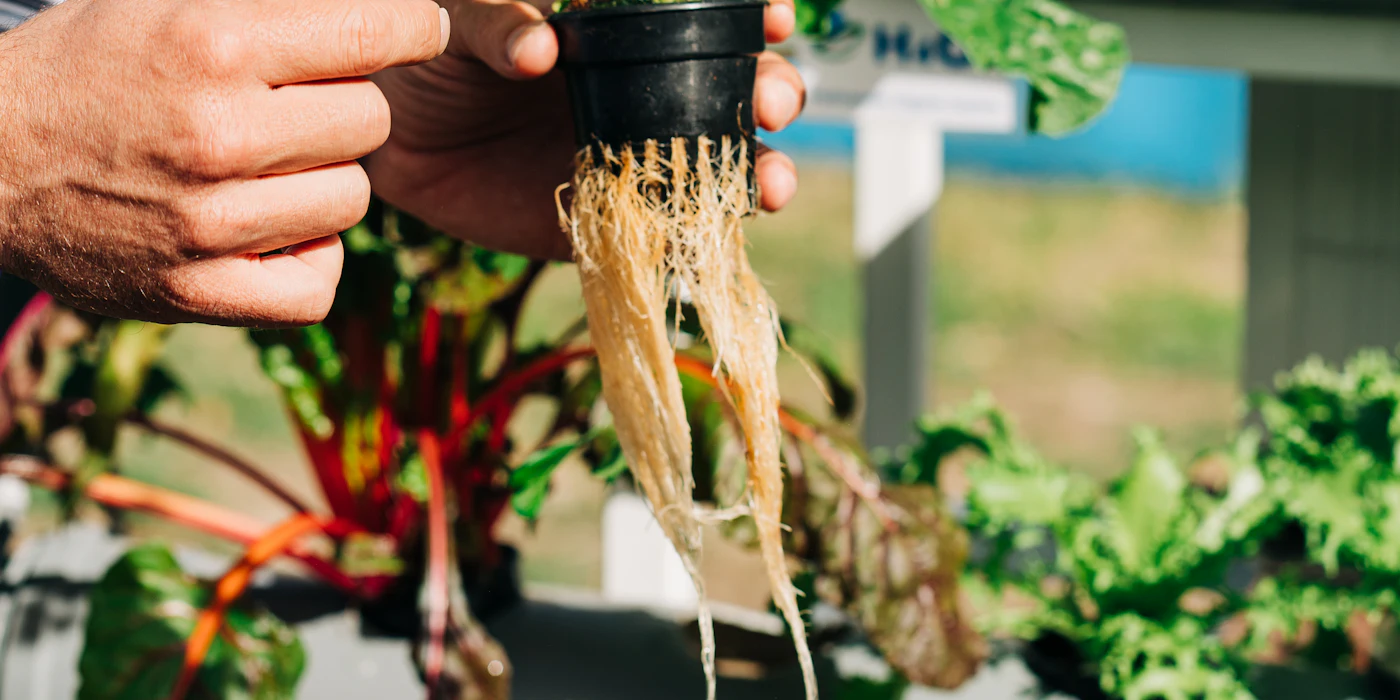
In a Kratky container there is no soil to hold nutrients or buffer mistakes. Everything the plant eats comes from the water in the container, so the solution has to be complete from the first day. This guide explains what that means.
What a nutrient solution is
A nutrient solution is water with mineral salts dissolved in it. When the salts dissolve they split into charged particles (ions) that roots can take up directly. In the Kratky method the whole batch is mixed before planting, and the plant draws it down over the life of the crop (Kratky, 2009).
The nutrients plants need
Plants need the same elements whether they grow in soil or water. They are usually grouped by how much the plant uses:
- Primary macronutrients: nitrogen (N), phosphorus (P) and potassium (K). These are the three numbers on a fertilizer label.
- Secondary macronutrients: calcium (Ca), magnesium (Mg) and sulfur (S). Plants use them in large amounts too, but they are often missing from simple fertilizers.
- Micronutrients: iron, manganese, zinc, copper, boron and molybdenum, needed only in small amounts but essential.
Soil supplies some of these on its own. Water does not, so a hydroponic nutrient has to supply all of them.
Why garden fertilizer is not a substitute
Most fertilizers sold for lawns and garden beds assume soil will make up the difference. Many contain little or no calcium, magnesium or micronutrients, and some supply nitrogen in forms that soil microbes convert before plants use them. In a still container of water those gaps show up quickly as pale, stunted or distorted growth. Choose a product labelled for hydroponics and follow its rate for non-circulating systems (UF/IFAS).
Two numbers that describe a solution
- Strength (EC or PPM): how much dissolved fertilizer is in the water. Too weak and the plant runs short; too strong and roots are stressed (Oklahoma State University Extension).
- pH: how acidic the solution is. pH controls whether the nutrients that are present can actually be absorbed.
Getting these two numbers right at mixing time is most of what separates a healthy Kratky crop from a struggling one.
What the solution does not do
A good solution cannot fix poor light, a container that lets light in, or roots kept underwater with no air gap. It is one part of a working setup, alongside the container and the air space that opens as the plant drinks.
How I think about a complete solution
When I look at a nutrient for a Kratky container, I picture the container as a closed pantry. Whatever goes in on mixing day is all the plant gets, because nothing circulates and nothing is replaced. That makes completeness the first thing I check, ahead of price, brand or how the bottle looks. A product that leaves out calcium or magnesium may grow a decent plant for a week or two, then stall once the plant has used up what the water happened to carry.
It also helps to remember that the plant takes up water and nutrients at different rates. As the level falls, the solution left behind can get stronger or weaker depending on the crop, the weather and the stage of growth. A complete, balanced starting point gives the plant the best chance of staying in range as that happens.
Why each group of nutrients matters
I find the three groups easier to remember by what goes wrong when one is missing:
- Nitrogen, phosphorus and potassium drive leaf growth, roots and overall vigor. A shortage of nitrogen usually shows first as older leaves turning evenly pale.
- Calcium, magnesium and sulfur build cell walls and chlorophyll. Calcium is the one I watch in lettuce, because it is linked to tipburn on the youngest inner leaves (UMass Extension).
- Micronutrients such as iron are needed in tiny amounts, but without them new growth turns pale between the veins. Iron problems are often a pH problem rather than a supply problem (Greenhouse Grower, with Neil Mattson).
What soil does that water cannot
Soil holds nutrients on its particles and releases them slowly. It also buffers pH, so a small mistake does little harm. Oklahoma State University Extension makes the point that this buffer is missing in soilless growing, which is why strength and pH have to be managed directly. In a Kratky container that management happens almost entirely at mixing time, so I take a few extra minutes to measure rather than guess.
My short checklist before mixing
- The label says the product is for hydroponics, and it lists calcium, magnesium and micronutrients.
- I know the EC and pH of my plain water.
- I have a way to measure the dose accurately: a syringe for liquids or a small scale for powders.
- I have pH down on hand, because most solutions need lowering after the nutrient goes in.
- The container is clean and lightproof, so the solution I mix stays the solution the plant gets.
If you are unsure which product to buy, the choosing a nutrient guide walks through one-part, two-part and three-part formulas. For the difference between a hydroponic nutrient and a bag of garden fertilizer, see hydroponic nutrients vs regular fertilizer, and for reading the three numbers on the front of the bottle, see what the N-P-K numbers mean.
Sources
- Kratky, B.A. (2009). Three non-circulating hydroponic methods for growing lettuce. Acta Horticulturae 843: 65–72.
- University of Florida IFAS Extension. Set It and Forget It Hydroponics (HS1488).
- Dunn, B. and Singh, H. Oklahoma State University Extension. Electrical Conductivity and pH Guide for Hydroponics (HLA-6722).
All Kratky Nutrient Solution Guides