
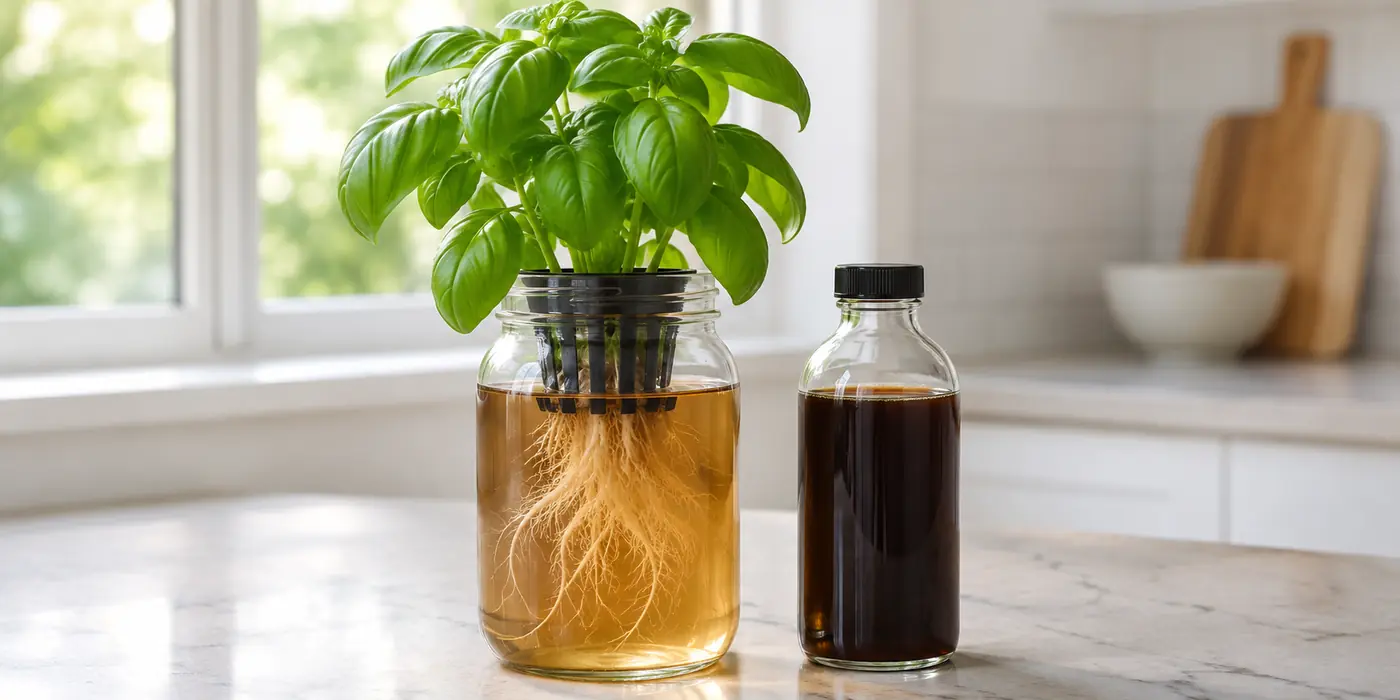
Short answer: it is possible, but it is harder than using a mineral hydroponic nutrient and it fails more often. Organic fertilizers depend on microbes to release their nutrients, and in a still Kratky container that microbial activity can use up oxygen and cause odors and slimy roots.
Why organic fertilizers behave differently
Most organic fertilizers supply nutrients bound in organic matter, such as proteins from fish or plant material. Microbes break that matter down into forms roots can absorb, such as nitrate. In soil this happens slowly and safely. In a container of water with no circulation, the same process can:
- Use up dissolved oxygen that roots need
- Produce sour or rotten smells
- Coat roots and container walls with slime or biofilm
- Make strength and pH harder to predict and measure
Why the Kratky method is especially sensitive
A Kratky container is never aerated, drained or refreshed. Any problem that starts in the solution stays there until harvest. Mineral nutrients are already in a form plants can use, so they do not need microbial breakdown and do not feed the same microbial bloom.
If you want to try
- Use a liquid product labelled for hydroponic use, not a soil amendment.
- Start with a small container you can afford to lose.
- Keep the solution cool and the container lightproof.
- Check roots and smell regularly; start over at the first sign of rot.
EC readings with organic products
Much of the nutrient in an organic fertilizer is not yet in dissolved, charged form, so an EC meter underestimates how much is there. Follow the label rate rather than chasing a target EC.
For a reliable first crop, a complete mineral hydroponic nutrient is the simpler choice.
Why I steer first-time growers away from organic products
I have nothing against organic growing. My concern is specific to the Kratky method. A Kratky container is still water that is never aerated, drained or refreshed, and the plant depends on the air space above it for oxygen. Anything that uses up oxygen in the solution or coats the roots works directly against the method. Microbial breakdown of organic matter does both, which is why mineral nutrients are so much more predictable in this one setting.
What a struggling organic container looks like
- A sour, rotten or eggy smell when the lid is lifted
- Cloudy solution, often with a film on the surface
- Roots that look brown, coated or slimy rather than white and firm
- Plants that wilt during the day even though the solution level is fine
Any of these means oxygen is running short at the roots. In still water, these problems rarely improve on their own; the plant needs a clean container and fresh solution. The problems and fixes guide covers root rot and smelly solution.
If you still want to try
Treat it as an experiment rather than your main crop. Choose a liquid organic product labelled for hydroponic use, not a soil amendment or a granular feed. Mix it at the label rate and do not chase an EC target, because much of the nutrient is not yet in a dissolved, charged form and a conductivity meter underestimates it. Keep the container cool, lightproof and well sealed, and check the smell and roots every few days. Leafy greens, which finish quickly, give the best chance of success.
A middle path
Some growers want to keep inputs simple without going fully organic. A complete mineral hydroponic nutrient, mixed carefully at the right strength and pH, is about as simple as it gets: one or two bottles, measured once, with nothing that needs breaking down. The choosing a nutrient guide explains what to look for, and hydroponic nutrients vs regular fertilizer covers why soil products fall short in water.
Cleaning up after an organic batch
Organic residues leave biofilm on container walls and net cups. Before reusing anything, I scrub it thoroughly, rinse well and let it dry completely, so the next crop does not start with a head start of microbes.
Quick questions
Does an air stone fix the problem?
It can help, because it adds oxygen, but then the system is no longer Kratky; it is closer to deep water culture, which UC Master Gardeners describe as an active system with an air pump and air stone.
Are organic hydroponic nutrients certified for organic growing?
Some are. Check the label and the certifier if certification matters to you, and follow the hydroponic rate on the bottle.
Is the produce safer with organic nutrients?
That is outside what this site covers. What I can say is that mineral nutrients are more predictable in still water.
Related guide: choosing a nutrient for Kratky.