
Topping Up and Replacing Kratky Nutrient Solution
The Kratky method was designed so that you add solution once and do nothing else (Kratky, 2009). Knowing why helps you decide what to do when a container runs low before harvest.
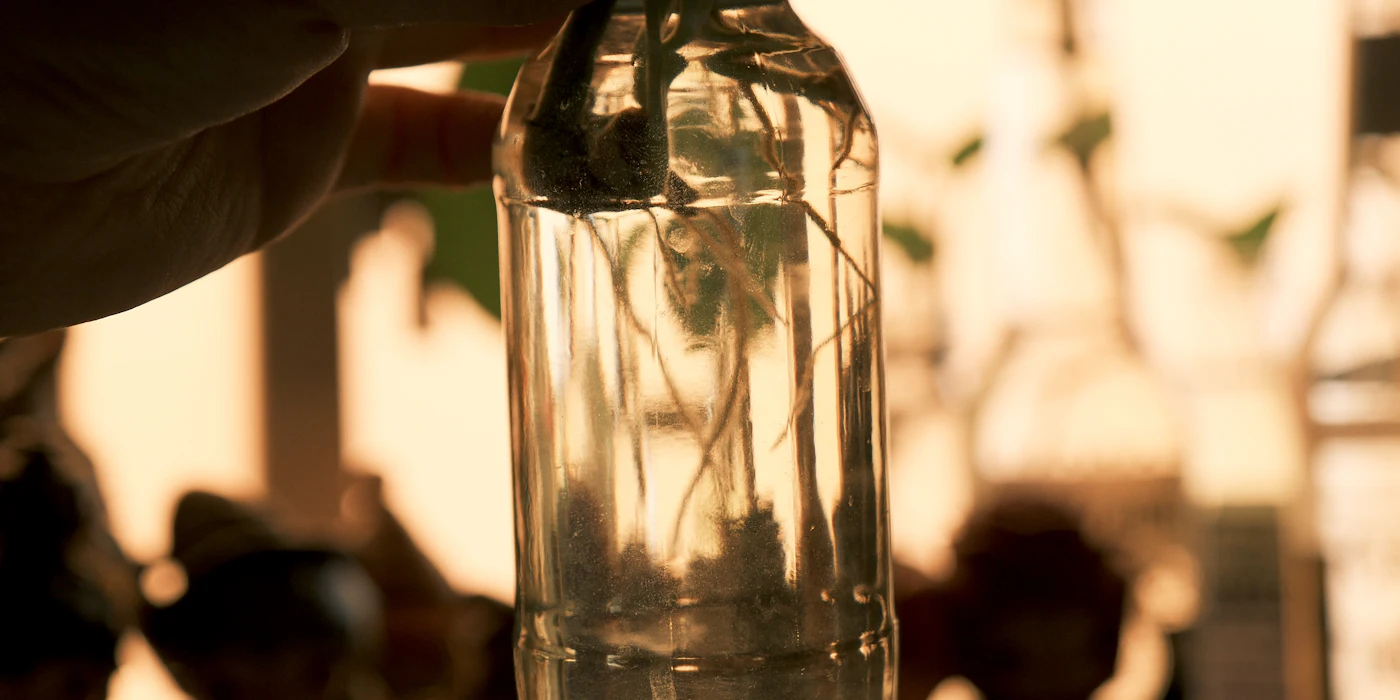
How the air gap works
At planting, the solution touches the bottom of the net cup. As the plant drinks, the level drops and a moist air space opens between the lid and the solution (Kratky, 2009). The plant grows two kinds of roots: air roots in the humid space, which take in oxygen, and water roots below, which take up water and nutrients (UC Master Gardeners, UC ANR). This is why a Kratky container needs no air pump.
The main rule: do not refill to the top
Once air roots have formed, filling the container back to its original level puts them underwater, and they can no longer supply oxygen. Roots that stay submerged can rot. If you need to add solution, keep the new level below the air roots.
Plan so you do not need to top up
For short crops such as lettuce, the simplest approach is a container large enough to hold all the solution the plant will use. UF/IFAS suggests roughly 1 to 1.5 gallons per plant for leafy greens. Kratky's lettuce trials were harvested before the solution ran out (Kratky, 2009).
If a container runs low before harvest
- Measure the EC of what is left. Strength can rise or fall as the plant draws the solution down.
- If the EC is high, top up with plain water. If it is close to your target, top up with fresh solution at normal strength. If it is low, top up with solution.
- Add only enough to reach the lower roots, well below the air roots.
Long-season and fruiting crops
Tomatoes, peppers and cucumbers grow for months and use far more water than lettuce. UC Master Gardeners note that fruiting crops usually need the solution replenished over time. Use a large reservoir, top up regularly in small amounts to keep the level in a steady band, and measure EC and pH each time.
When to start over
- After every harvest: empty, clean and rinse the container and mix a fresh batch
- If the solution smells bad, turns cloudy or slimy
- If roots turn brown and soft
Reusing old solution carries over imbalances and microbes from the previous crop.
Sources
- Kratky, B.A. (2009). Three non-circulating hydroponic methods for growing lettuce. Acta Horticulturae 843: 65–72.
- UC Master Gardeners of Orange County, UC ANR. Kratky Hydroponics: Soil-Free Growing Method.
- University of Florida IFAS Extension. Set It and Forget It Hydroponics (HS1488).
