
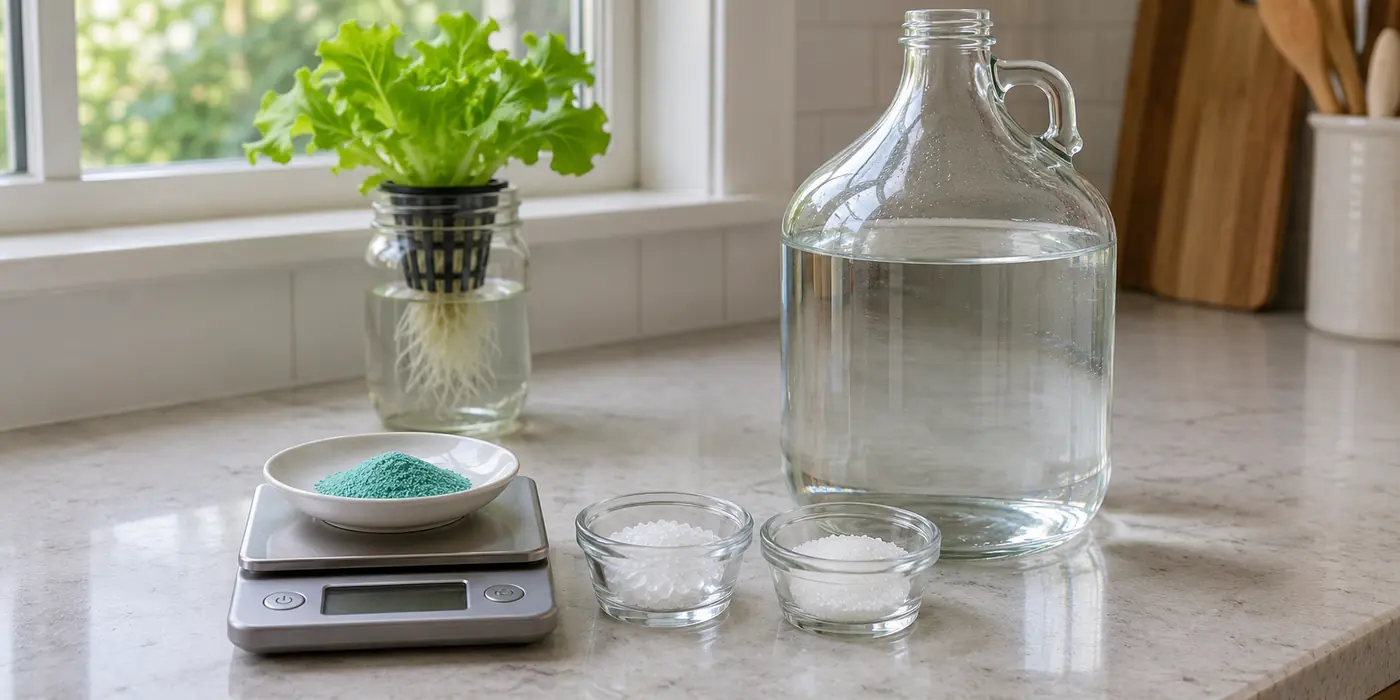
Short answer: Masterblend's own mixing sheet for its 4-18-38 Tomato Formula gives, per U.S. gallon of water, 2.4 grams of 4-18-38, 1.5 grams of magnesium sulfate (Epsom salt) and 2.4 grams of calcium nitrate, dissolved one at a time in that order. The sheet says to use half those rates while seedlings are getting established.
Some links on this page go to Amazon. As an Amazon Associate we earn from qualifying purchases. The products are described from their makers' labels and published specifications, not from side-by-side trials.
The recipe, from the maker's sheet
MasterBlend 4-18-38 is one part of a three-part powder recipe. The 4-18-38 bag supplies phosphorus, potassium and micronutrients; calcium nitrate supplies calcium and most of the nitrogen; Epsom salt supplies magnesium and sulfur. The amounts below are Masterblend's figures for the U.S. column of its mixing sheet.
| Water | 4-18-38 | Magnesium sulfate | Calcium nitrate |
|---|---|---|---|
| 1 gallon | 2.4 g | 1.5 g | 2.4 g |
| 2 gallons | 4.5 g | 2.8 g | 4.5 g |
| 10 gallons | 23 g | 14 g | 23 g |
| 25 gallons | 57 g | 35 g | 57 g |
The metric column works out to the same strength: 2.4 g of 4-18-38, 1.5 g of magnesium sulfate and 2.4 g of calcium nitrate per 4 liters, or 0.6 g, 0.375 g and 0.6 g per liter.
Per jar
These are the gallon rates divided down. The math is mine; the rates are Masterblend's.
| Jar | 4-18-38 | Magnesium sulfate | Calcium nitrate |
|---|---|---|---|
| Quart (32 fl oz) | 0.6 g | 0.38 g | 0.6 g |
| Half gallon (64 fl oz) | 1.2 g | 0.75 g | 1.2 g |
| Gallon | 2.4 g | 1.5 g | 2.4 g |
Weighing 0.38 g accurately needs a scale that reads to 0.01 g, and most kitchen scales do not. That is why I never weigh for a single quart jar. I mix a full gallon at the gallon rate and pour it into the jars, which is the approach in how to measure nutrient doses for mason jars.
Mixing order matters
Masterblend's sheet lists four steps: choose the amount of finished solution, dissolve the 4-18-38, add the magnesium sulfate and dissolve it completely, then add the calcium nitrate and dissolve it completely. I follow that order and stir until each powder has fully disappeared before adding the next.
The reason is chemistry, not fussiness. Dr. Kratky's own stock-solution sheet from the University of Hawaii keeps calcium nitrate in a separate concentrate from the fertilizer and magnesium sulfate, because they react when concentrated, but not once diluted in the growing solution. Adding each powder to the full volume of water keeps everything dilute. Never premix the three dry powders in one jar, and never dissolve them together in a small cup of water. The longer story is in why two-part nutrients come in two bottles.
Seedlings get half strength
The sheet's note is short: use half rates during initial growth until seedlings are well established. For a gallon that is 1.2 g, 0.75 g and 1.2 g. In a Kratky jar, where the whole crop runs on the first fill, I start lettuce on the full rate only if the seedling is already a few true leaves along; anything younger gets the half rate.
Do not use the garden-can rate
Masterblend's retail page gives a different instruction: one tablespoon of 4-18-38 per gallon of water, fed once a week, with half a teaspoon of Epsom salt and a teaspoon of calcium nitrate for best results. That is a rate for watering plants in soil once a week, not for a hydroponic solution that sits on the roots for the whole crop. A tablespoon of powder is far more than 2.4 grams. For Kratky, I use the mixing sheet and a scale, never the spoon rate.
Checking the result
If you have an EC meter, measure the finished batch. Dr. Kratky mixed his lettuce solutions to about 1.5 mS/cm, and Oklahoma State University Extension's crop table gives 1.2 to 1.8 mS/cm for lettuce. Measure your plain water first, because hard water adds to the reading; how hard water affects Kratky nutrient solution shows how to account for it. Then check pH; the targets are in the pH guide.
What to buy
- A MasterBlend 4-18-38 kit that includes calcium nitrate and Epsom salt, so all three parts arrive together
- A digital scale that reads to 0.01 g, for small batches
- A gallon jug or bucket kept only for mixing
A pound of 4-18-38 (453.6 g) at 2.4 g per gallon makes about 189 gallons of solution, so a small kit lasts a long time for a few jars.
Quick questions
Can I use MasterBlend's 8-15-36 Lettuce Formula instead?
Masterblend lists an 8-15-36 Lettuce Formula among its hydroponic products, but the rates above are for 4-18-38 only. Use the instructions that come with whichever formula you buy; do not swap one formula into another's recipe.
Do I have to use all three parts?
Yes. The 4-18-38 label lists only 4% nitrogen and no calcium. Leaving out calcium nitrate leaves the solution short of calcium and most of its nitrogen.
Related guide: choosing a nutrient for Kratky hydroponics. Also see MasterBlend vs General Hydroponics Flora.
Sources
- Masterblend International. 4-18-38 Tomato Formula: Masterblend Mixing Instructions.
- Masterblend International. Tomato & Vegetable Formula 4-18-38.
- Masterblend International. Hydroponics.
- Kratky, B.A. University of Hawaii CTAHR. Fertilizer Stock Solutions for Lettuce.
- Kratky, B.A. 2009. Three Non-Circulating Hydroponic Methods for Growing Lettuce. Acta Horticulturae 843:65-72.
- Dunn, B. and Singh, H. Oklahoma State University Extension. Electrical Conductivity and pH Guide for Hydroponics (HLA-6722).