
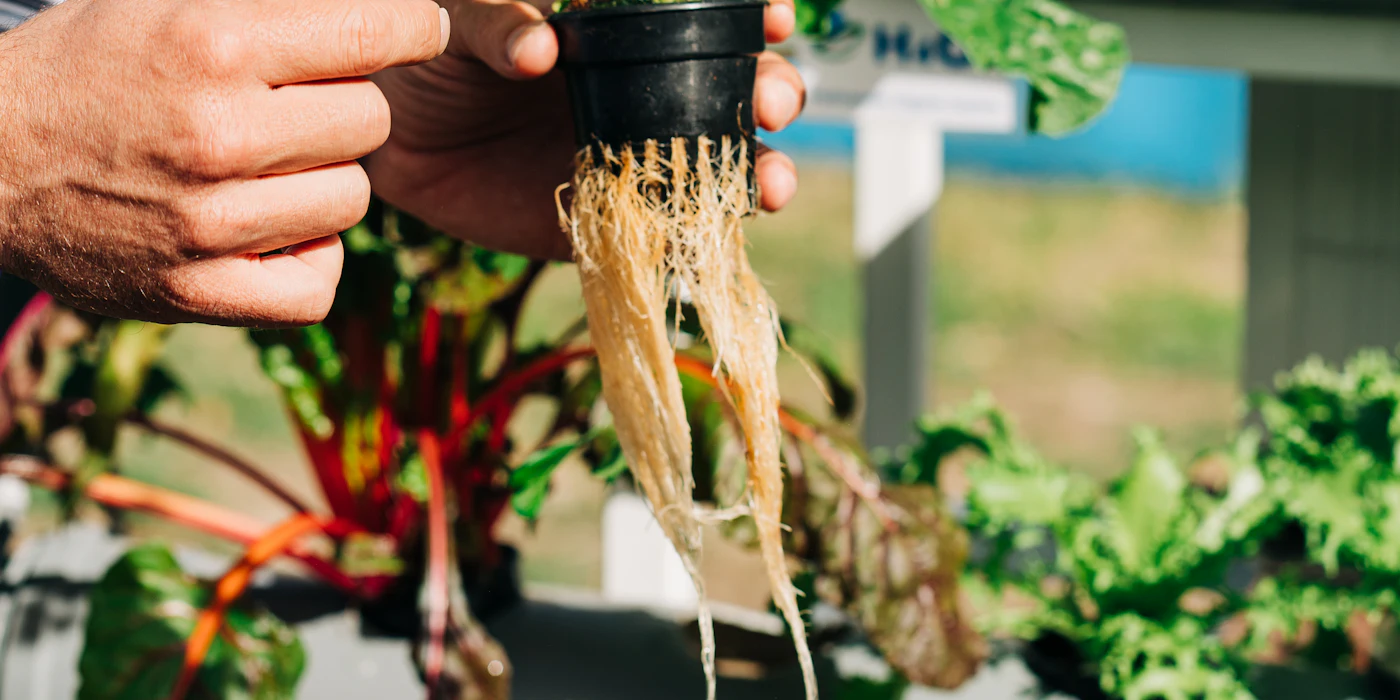
Short answer: root rot in Kratky shows up as brown, soft, slimy roots, a bad smell and plants that wilt or stall even though the container has solution in it. It is usually caused by the roots running short of oxygen, most often because the solution is warm or the air gap has been flooded, which lets water molds such as Pythium take hold. Once it starts it is hard to reverse, so prevention matters most.
What root rot looks like
Penn State Extension describes the symptoms of Pythium root rot as:
- Stunted plants
- Brown, dead root tips
- Wilting at mid-day, with plants recovering at night
- Plants yellowing and dying
- Brown tissue on the outer part of the root that pulls off easily, leaving a strand of inner tissue exposed
In a Kratky container I also look for a sour or rotten smell and slime on the roots. Healthy roots are white or cream and firm, and the fine air roots above the solution should look dry and fuzzy, not wet and brown.
The wilting pattern is the clue many people miss. A plant that droops in the afternoon even though its roots are sitting in solution is not short of water. Its roots cannot take water up.
Why Kratky containers are prone to it
The air gap is the oxygen supply
The Kratky method uses no pumps or aeration. As plants drink, the water level drops and creates an air gap that supplies oxygen to the roots (UC Master Gardeners). Refilling to the top floods the roots that grew into that gap. They were not built to live underwater, and they start to die.
Warm water holds less oxygen
The U.S. Geological Survey notes that cold water can hold more dissolved oxygen than warm water. Cornell University's hydroponic lettuce research recommended dissolved oxygen of at least 4 mg/L for good growth and saw severe plant stress below 2 mg/L. In the same research, lettuce could be grown well in a warm greenhouse only if the root zone was kept below 20 °C (68 °F). A Kratky container sitting in the sun has no way to cool itself.
Light and debris
Light lets algae grow, and decaying algae, leaves or dead roots feed microbes that use up oxygen in the water.
What I do when I find it
Penn State Extension is blunt: Pythium root rot is difficult to control once the rot has begun, and every effort should go into preventing it. So I am realistic about what can be saved.
- Judge the plant. If most of the roots are brown and the plant is wilting, I harvest what I can or discard it. If only some roots are affected and the plant is still firm, it may be worth moving.
- Move it to clean conditions. A clean container, fresh solution at the normal strength and pH, filled only to the level the healthy roots can reach, so some roots stay in the air.
- Never reuse the old solution. The UC Master Gardeners note that a disease or root problem can spread quickly through a shared nutrient solution.
- Clean everything. Penn State Extension advises cleaning and disinfecting reservoirs and tools. I scrub the container, rinse it well and let it dry before using it again.
How I prevent it
- Keep containers out of direct sun and in the coolest spot available. Oklahoma State University Extension gives 72 to 75 °F as the optimal solution temperature, and cooler is safer for lettuce in summer.
- Never refill to the top once air roots have formed.
- Use lightproof containers and lids.
- Start with clean water. Penn State Extension notes that some Pythium species live in pond and stream water and their sediments, so I do not use them in Kratky containers.
- Size the container so the plant does not run dry before harvest, which avoids the temptation to top up.
Root rot or something else?
Brown roots are not always rot. Some nutrients and tea-colored water can stain roots without harming them. The test is texture and smell: stained roots are firm and smell clean, rotting roots are soft, slimy and smell bad. Yellow leaves with healthy white roots point to a nutrient or pH problem instead; see why Kratky leaves turn yellow.
Quick questions
Can a plant recover from root rot?
Sometimes, if the damage is limited and the conditions that caused it are fixed. New white roots are the sign that it is recovering.
Should I add an air stone?
That turns the container into deep water culture, a different system that needs electricity. If you keep the Kratky method, fix the temperature and the air gap instead.
Related guide: Kratky nutrient solution problems and fixes. Also see why Kratky solution turns cloudy or smelly.
Sources
- Moorman, G.W. Penn State Extension. Pythium.
- UC Master Gardeners of Orange County. Hydroponics for the Home Gardener.
- U.S. Geological Survey Water Science School. Dissolved Oxygen and Water.
- Both, A.J. Ten Years of Hydroponic Lettuce Research (Cornell University Controlled Environment Agriculture program).
- Dunn, B. and Singh, H. Oklahoma State University Extension. Electrical Conductivity and pH Guide for Hydroponics (HLA-6722).