
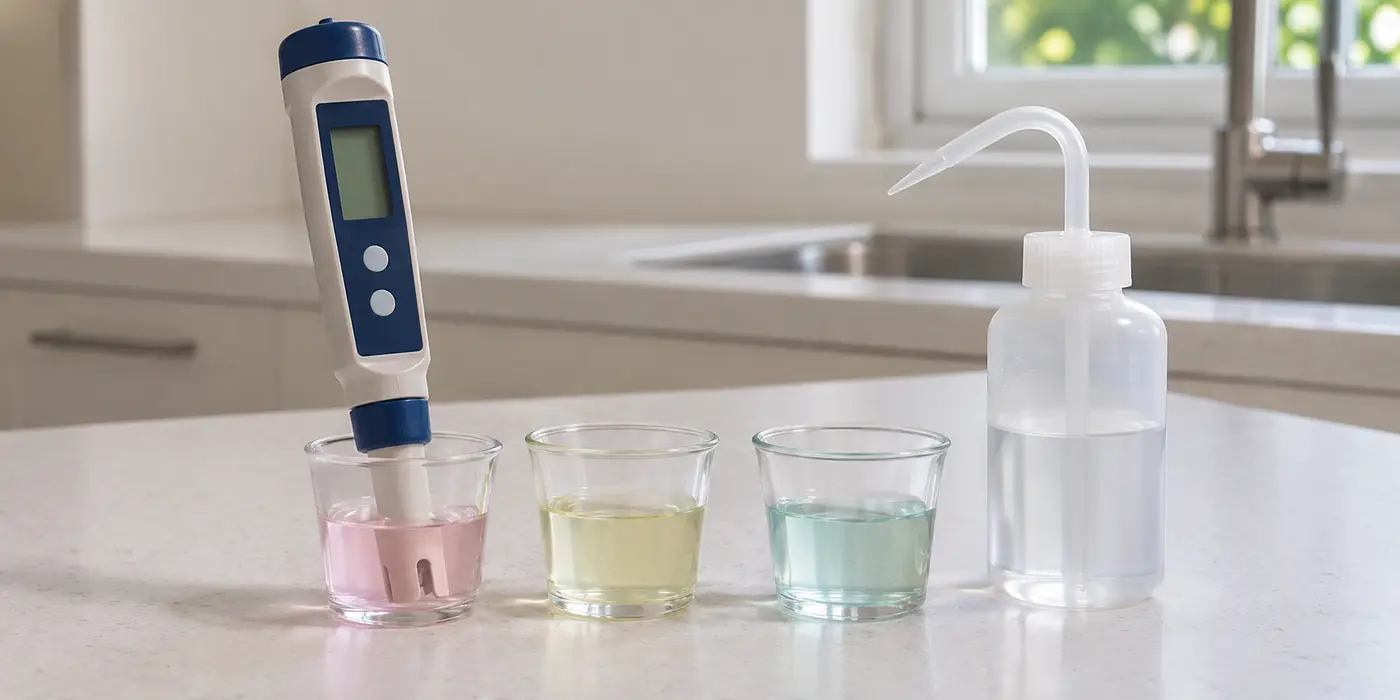
Short answer: choose a pH meter with two-point calibration (pH 7 plus pH 4), automatic temperature compensation, a resolution of 0.1 pH or better, and a probe cap that keeps the probe moist. A replaceable probe is worth paying for, because the probe wears out long before the meter does. Buy calibration buffers and storage solution with it.
Some links on this page go to Amazon. As an Amazon Associate we earn from qualifying purchases. The products are described from their makers' labels and published specifications, not from side-by-side trials.
Why pH meters need more care than EC meters
An EC probe is two electrodes; a pH probe is a glass bulb filled with a reference solution. The glass has to stay hydrated, and the probe ages. Oklahoma State University Extension describes calibrating pH meters with buffer solutions, commonly pH 4, 7 or 10, and cleaning and storing the probe in solution after use. That care is the real cost of a pH meter, so the features worth paying for are the ones that make it easy.
1. Two-point calibration
A two-point calibration sets the meter at pH 7 and at a second buffer. For hydroponics the second point should be pH 4, because Kratky solutions sit below 7; UF/IFAS gives a target of about 5.5 to 6.0. Bluelab's pH Pen and pH PenPlus both list simple two-point calibration with a 30-day reminder. A one-point meter is less accurate across the range.
2. Automatic temperature compensation
pH readings shift with temperature, so look for automatic temperature compensation in the specifications. Bluelab's pens also display the temperature, which is useful in its own right; see what temperature Kratky solution should be.
3. Resolution
A reading to 0.1 pH is enough to tell whether you are inside a half-unit target band. Some meters read to 0.01; Bluelab lists 0.01 pH resolution on its OnePen. That precision is nice for troubleshooting but rarely changes what you do in a Kratky container.
4. A probe that stays moist
A pH probe that dries out reads slowly and drifts. Look for a cap that holds storage solution. Bluelab describes the PenPlus cap as KCl-filled silicone with an internal sponge to keep the probe hydrated. Store the probe in storage solution, never in plain or distilled water.
5. A replaceable probe
When a probe will no longer calibrate, a meter with a fixed probe has to be replaced whole. Bluelab sells the pH PenPlus with a screw-cap replaceable pH and temperature probe, alongside its standard pH Pen. The OnePen also has a replaceable probe. If you plan to test for years, this is the feature I would pay extra for.
What to buy with it
- pH 4.0 and 7.0 calibration buffers
- Probe storage solution (KCl)
- Distilled water for rinsing the probe between buffers
- Small clean cups, so you never dip the probe into the buffer bottles
Bluelab sells a probe care kit with single-use pH 4.0 and 7.0 sachets, KCl storage solution and cleaners, which is a tidy way to get everything at once.
Examples that meet the checklist
| Meter | What stands out |
|---|---|
| Bluelab pH Pen | Double-junction probe, two-point calibration with a 30-day reminder, waterproof and floats |
| Bluelab pH PenPlus | The same idea with a replaceable screw-cap probe and an IP68 rating |
| Bluelab OnePen | pH, EC and temperature in one pen, replaceable probe, 0.01 pH resolution |
These are examples with published specifications, not the only good choices; check any other meter against the same five points.
Calibrating for the first time
- Pour a little pH 7.0 and pH 4.0 buffer into separate clean cups.
- Rinse the probe in distilled water and shake it gently.
- Calibrate at pH 7.0 first, following the meter's instructions, then rinse.
- Calibrate at pH 4.0, then rinse again.
- Throw the used buffer away and put the probe back in its storage cap.
Bluelab recommends fresh pH 7.0 and 4.0 solutions for its meters. I note the date on a strip of tape on the case, so when a reading looks odd the first question, how long since calibration, has an answer.
Or skip the meter
Many Kratky growers do fine with a liquid drop kit, because pH is mostly checked on mixing day. pH strips, drops or a meter compares the options. I keep a drop kit even with a meter, as a cross-check when a reading looks wrong.
Quick questions
How often should I calibrate?
Follow the maker; Bluelab's pens remind you every 30 days. I also calibrate before any batch that matters.
How do I know the probe is worn out?
It drifts, reads slowly or will not calibrate even with fresh buffers and a clean probe. That is when a replaceable probe pays for itself.
Related guide: supplies for mixing Kratky nutrient solution. Also see how to choose an EC or TDS meter.
Sources
- Dunn, B. and Singh, H. Oklahoma State University Extension. Electrical Conductivity and pH Guide for Hydroponics (HLA-6722).
- University of Florida IFAS Extension. Set It and Forget It Hydroponics (HS1488).
- Bluelab. Bluelab pH Pen.
- Bluelab. Bluelab pH PenPlus.
- Bluelab. Bluelab OnePen.
- Bluelab. Bluelab Probe Care Kit: pH and Conductivity.