
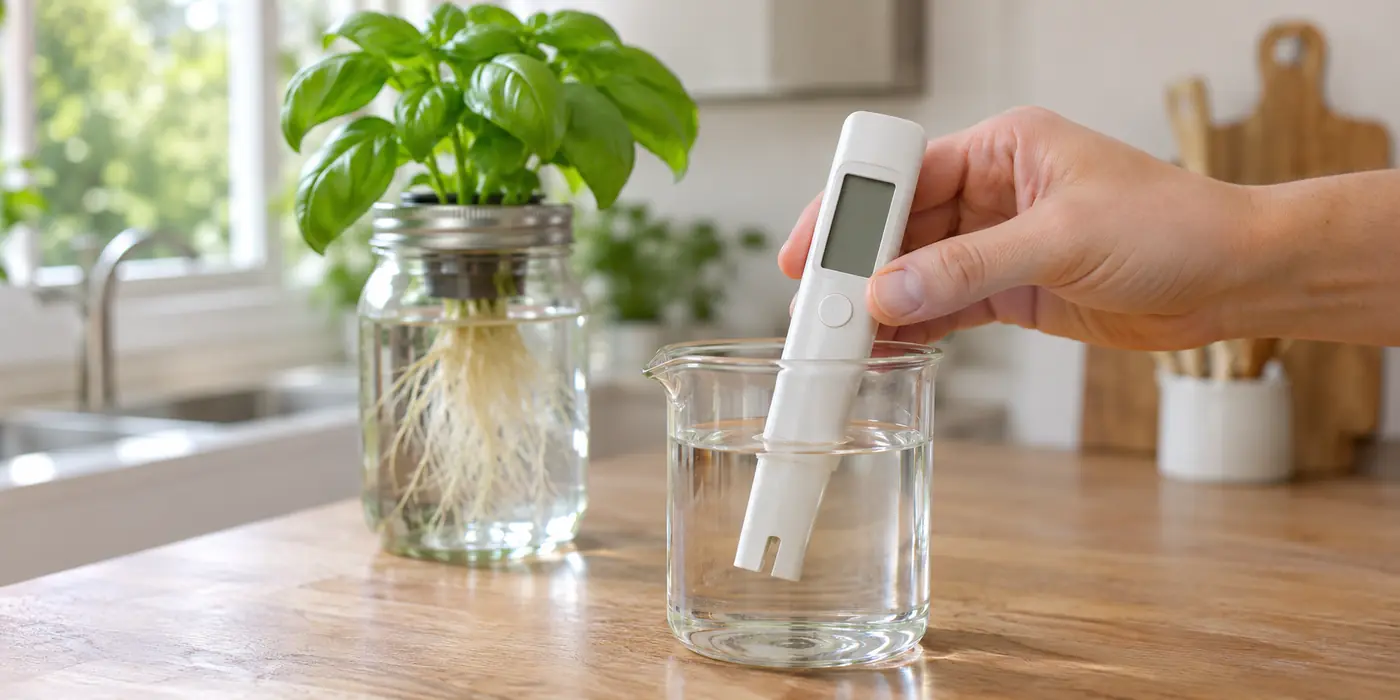
Short answer: choose a meter that shows EC (or tells you which PPM scale it uses), corrects for temperature automatically, can be calibrated or checked against a standard, and reads accurately in the 0.5 to 3 mS/cm range Kratky solutions fall in. A waterproof body and a clear display matter more than extra features.
Some links on this page go to Amazon. As an Amazon Associate we earn from qualifying purchases. The products are described from their makers' labels and published specifications, not from side-by-side trials.
1. EC readout, or a PPM scale you know
EC and TDS meters measure the same thing, electrical conductivity. A TDS or PPM meter then multiplies by a conversion factor, usually 500 or 700, and different makers use different factors. A meter that shows EC in mS/cm avoids the confusion, because EC means the same on every meter and published ranges, such as Oklahoma State University Extension's crop table, are given in EC. If you buy a PPM meter, make sure the manual says which scale it uses. How to convert EC to PPM has the chart.
2. Automatic temperature compensation
Conductivity rises with temperature, so the same solution reads differently when it is warm. Meters with automatic temperature compensation (ATC) correct the reading to a reference temperature. Bluelab's Conductivity Pen lists ATC, and its Truncheon gives readings "adjusted for temperature." I would not buy a meter without it.
3. Calibration
Oklahoma State University Extension describes calibrating by placing the probe in a solution of known EC, usually 1.41 mS/cm, and setting the meter to that value. Most pocket meters work this way. Some meters are factory calibrated instead: Bluelab says its Truncheon needs no calibration and that its Conductivity Pen is factory calibrated and ready to use. Either way, a bottle of standard solution lets you check the reading. The steps are in how to calibrate an EC or TDS meter.
4. Range and resolution
Kratky targets sit roughly between 1 and 2 mS/cm for most crops, and plain tap water may read a few tenths. A meter that reads in steps of 0.1 mS/cm is enough. Bluelab lists the standard Truncheon at 0.2 to 3.6 EC with 0.1 resolution and ±0.1 accuracy at 25 °C, and a Commercial Truncheon that reads to 6.0 EC for stronger solutions, which Kratky growers rarely need.
5. Build and probe
- Waterproof, or at least splash-proof; meters end up in buckets.
- A probe you can clean. Dried salts on the sensor cause drift.
- A replaceable probe extends a meter's life. Bluelab's OnePen, for example, has a replaceable pH and conductivity probe.
Three types, and who they suit
| Type | Example | Who it suits |
|---|---|---|
| Pocket EC/TDS pen | Bluelab Conductivity Pen and many low-cost calibratable pens | Most home Kratky growers |
| Dip stick meter | Bluelab Truncheon | Growers mixing in buckets or tubs who want no calibration |
| Combined pH and EC pen | Bluelab OnePen | Growers who would rather carry one tool |
Bluelab is used here as the example because it publishes full specifications; Hanna, Apera and others make comparable meters, and the same checklist applies to them.
The first hour with a new meter
- Read the manual for the scale it uses and how to calibrate or check it.
- Calibrate or check it against a standard, poured into a clean cup.
- Measure your plain tap water and write the number on the case or in a notebook. That is your baseline.
- Mix a batch at the label rate and measure it. Write that down too, with the amounts you used.
- Rinse the probe and store it as the maker says.
Those two numbers, plain water and a known batch, become a quick check later. If either reads differently next time, the meter or the water has changed, and you know before you mix a whole batch on a bad reading.
How much to spend
Oklahoma State University Extension describes professional EC and pH meters costing $100 to $500. A home Kratky grower does not need that. A low-cost pen that can be calibrated, and is calibrated, will tell you whether a batch is in range. What extra money buys is durability, a warranty and stable readings over years; Bluelab lists a five-year limited warranty on the Truncheon.
My checklist before buying
- Shows EC, or states its PPM scale
- Automatic temperature compensation
- Can be calibrated, or is factory calibrated and can be checked
- Reads to 0.1 mS/cm across 0 to 3 mS/cm
- Waterproof, with a cleanable probe
- A bottle of calibration standard bought with it
Quick questions
Do I need a meter at all?
Not strictly, but it makes problems much easier to diagnose; see do you need an EC meter for Kratky growing.
Can one meter do EC and pH?
Yes, combination pens exist. The pH side still needs its own calibration with pH buffers; see how to choose a pH meter.
Related guide: supplies for mixing Kratky nutrient solution.
Sources
- Dunn, B. and Singh, H. Oklahoma State University Extension. Electrical Conductivity and pH Guide for Hydroponics (HLA-6722).
- Bluelab. Bluelab Truncheon Nutrient Meter.
- Bluelab. Bluelab Conductivity Pen.
- Bluelab. Bluelab OnePen.