
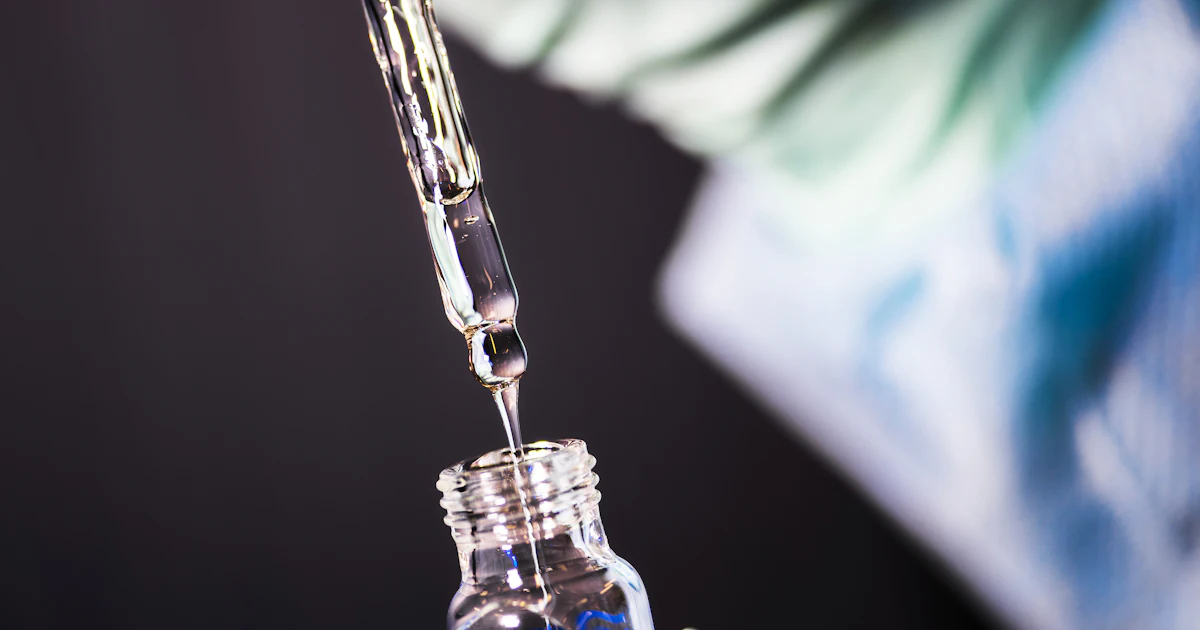
Short answer: to raise pH in Kratky nutrient solution, add a pH up product (usually potassium hydroxide or potassium carbonate) in very small amounts, stir, wait a few minutes and test again. Oklahoma State University Extension describes exactly this: add the product slowly and repeat until the reading reaches the target range.
Low pH is much less common in Kratky containers than high pH, so before reaching for pH up I like to understand why the reading is low. Most of the time the answer is that I added too much pH down.
The range to aim for
Oklahoma State University Extension recommends a nutrient solution pH between 5 and 6, usually 5.5, so the root environment stays around 6 to 6.5, where nutrients are most available. Its crop table gives some useful targets: 6.0 to 7.0 for lettuce, 5.5 to 6.0 for basil and 6.0 to 6.5 for tomatoes. I mix most batches to about 5.8, which sits comfortably inside the common 5.5 to 6.5 band.
If your reading is 5.3 and your target is 5.8, that is a small correction. If it is 4.5, something has gone wrong at mixing time and it is worth working out what before you fix it.
Why pH ends up too low
- Too much pH down. The most common cause by far. Acids are strong and a few drops go a long way in a jar.
- Very soft water. Distilled, reverse osmosis and rain water have almost no alkalinity, so there is nothing to resist a change. A dose of acid that barely moves hard tap water can drop pure water a long way.
- The nutrient itself. Formulas that contain some ammonium tend to pull pH down as plants grow, the opposite of nitrate-only formulas.
What to use
Oklahoma State University Extension lists potassium hydroxide, potassium carbonate or a pH up product for raising pH. Most hobby pH up bottles are one of the first two. Both add a little potassium, which plants use anyway, so the dose involved in a correction is not a concern.
Why I skip baking soda
Baking soda is sodium bicarbonate. It does raise pH, but it adds sodium, and Oklahoma State University Extension lists sodium among the salts to keep low, with under 50 ppm as the acceptable level in source water. Plants have no use for it, and in a Kratky container nothing flushes it out. A bottle of pH up costs little and avoids the problem.
How I raise pH step by step
- Calibrate the pH meter, or check that the strips or drops are in date.
- Measure EC first if you use a meter. Oklahoma State University Extension says pH should always be checked after the EC is in the optimum range, because adding nutrient changes pH.
- Dilute the pH up. For a single jar I put one drop into a small cup of solution rather than straight into the container.
- Add it gradually, stir gently and wait a few minutes.
- Test again. Repeat with smaller amounts as you get close to the target.
Stopping at 5.6 when you wanted 5.8 is fine. Chasing the last tenth is how people overshoot in both directions.
Raising pH in a container that is already growing
Once plants are in, I am careful not to raise the level. The air gap that opens as plants drink is what supplies oxygen to the roots in the Kratky method (UC Master Gardeners). So I mix the pH up into a very small amount of solution and pour it down the side, away from the roots. If the container needs more than a tiny correction, I would rather leave it than flood the air roots.
UF/IFAS notes that once a Kratky solution is balanced at mixing, there is rarely a need to keep adjusting it. In my view a slightly low reading on a healthy plant is not a reason to act.
How to avoid needing pH up at all
- Add pH down in small steps with a wait between each, as Oklahoma State University Extension advises for acids too.
- If you use soft water, expect it to swing further and start with a quarter of the dose you would use with tap water.
- Test the plain water before mixing, so you know whether it brings any alkalinity.
- Mix in a bucket rather than in each jar, so one correction covers several plants.
Signs that pH has been too low
Low pH changes which nutrients are easy for roots to take up, so the symptoms often look like a deficiency even when the nutrient is in the water. If leaves look poor and the reading is well below 5.5, correct the pH before adding more nutrient. Adding nutrient on top of a pH problem rarely helps and can push the EC too high.
Quick questions
Can I use pH up and pH down from different brands?
Yes. They are simple chemicals. Just add each one slowly and test between additions.
Will raising pH change the EC reading?
Very slightly, because pH up is a salt. The dose used for a correction is too small to matter in practice.
Related guide: managing pH in Kratky nutrient solution. For the opposite problem, see how to lower pH with vinegar or citric acid.
Sources
- Dunn, B. and Singh, H. Oklahoma State University Extension. Electrical Conductivity and pH Guide for Hydroponics (HLA-6722).
- University of Florida IFAS Extension. Set It and Forget It Hydroponics (HS1488).
- UC Master Gardeners of Orange County. Hydroponics for the Home Gardener.