
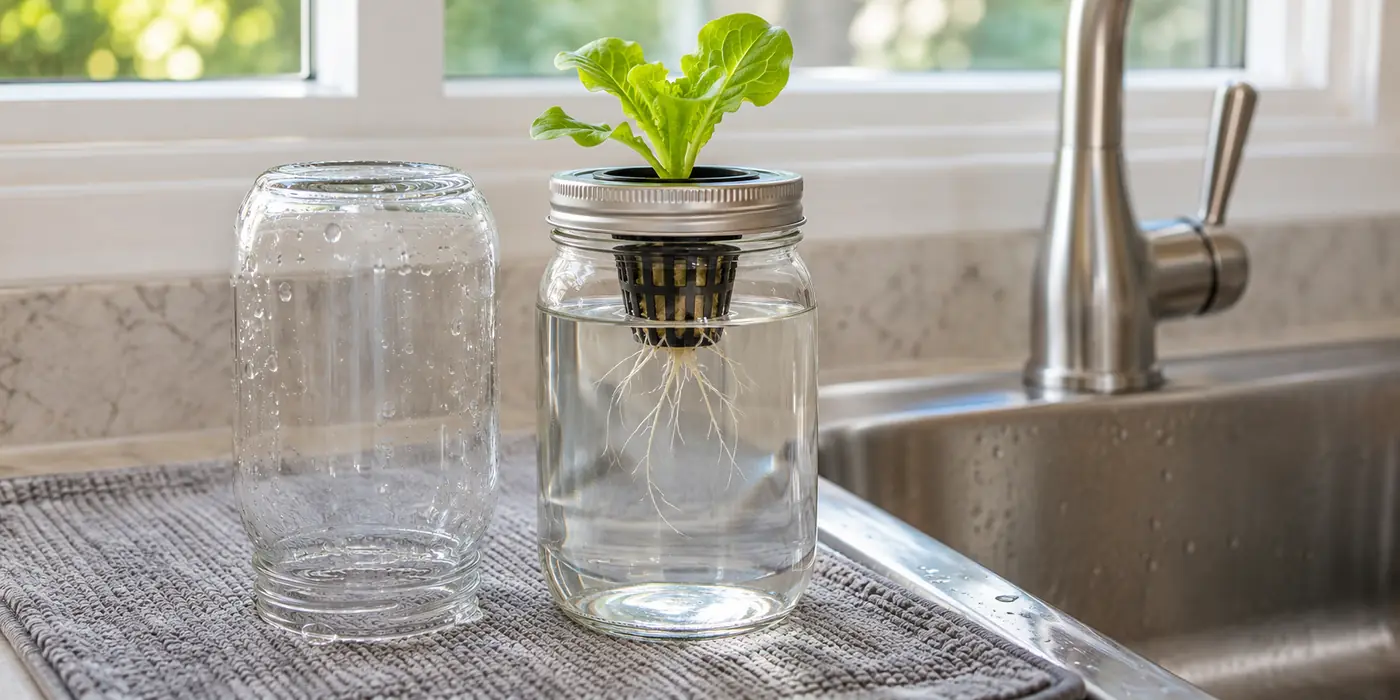
Short answer: in a home jar or bucket, replace the solution completely after every harvest. Dr. Kratky's own guidance for larger tanks is to drain and refill after every three crops or sooner, and after every crop if your water is poor. Replace it straight away, mid-crop if necessary, if it smells bad, turns slimy or the roots start to rot.
What Dr. Kratky says
In his 2009 paper on three non-circulating methods, Dr. Kratky describes commercial growers harvesting lettuce and replanting the same day. Some drain and refill the tanks after each crop; others top off the remaining solution with new nutrient solution. His rule: tanks should be drained and refilled after every three crops or sooner.
His 2004 paper describes the same choice and adds that plant growth continues until less than 10 percent of the original solution remains, when the crop is ended and a new one started. A well-sized Kratky container is close to empty at harvest, so the question is usually what to do with a small remainder.
Why the remainder goes bad
Salts concentrate
Plants take up water faster than some salts, and whatever the water brought with it stays behind. Dr. Kratky gives an example: water that starts at an EC of 0.5 mS/cm from salt contaminants may concentrate to 2.0 mS/cm when 25 percent of the original solution remains, which could lead to tipburn and other problems. That is why he says that with poor water the tanks must be emptied after each crop. Topping off that remainder starts the next crop with the salts already concentrated.
The balance has shifted
Plants do not take up every nutrient at the same rate. Oklahoma State University Extension notes that nutrient ratios drift beyond their useful limits over time, which is why it advises replacing the solution in recirculating systems every two weeks. The leftover solution in a Kratky container is not a weaker copy of the original; it is a different mix.
Microbes and debris
Dead roots, algae and plant debris in old solution feed microbes that use up oxygen. Starting a new crop in it hands those problems to young roots.
My rule for home containers
For jars, buckets and totes I replace everything after each harvest. Dr. Kratky's every-three-crops rule was written for large tanks replanted the same day, where draining is real work. In a quart jar the remainder is a cupful, and a fresh batch takes very little nutrient. Replacing it each time removes the guesswork about what the remainder contains.
- Pour out the remaining solution.
- Remove roots and debris, then scrub the container and lid.
- Rinse well and let it dry.
- Mix a fresh batch at the normal strength, check pH and fill to the level for a new seedling.
What to do with the old solution is covered in the mixing guide.
Size containers so the remainder is small
The less solution left at harvest, the less there is to decide about. Dr. Kratky's figures for lettuce give a starting point: his model system holds 4 to 8 liters of solution per plant, plants typically use 3 to 6 liters, and in Hilo a 200 gram lettuce used about 3 to 4 liters. A container sized close to what the crop will drink ends near empty, which is how the method is meant to work. A container that is far too big leaves a deep remainder that has had weeks to concentrate and change. How much solution a Kratky plant needs has the planning figures.
Replace mid-crop if you see these
- A sour, rotten or sewage smell
- Cloudy, slimy water; see why Kratky solution turns cloudy or smelly
- Brown, soft roots; see root rot in Kratky
When replacing mid-crop, fill only to the level the healthy roots can reach so the air roots stay in air. Dr. Kratky's papers are clear that the solution level may stay the same or drop but should not be raised over roots that have grown into the air space.
Long crops are different
Dr. Kratky notes that tomatoes need 25 to 40 liters of water per kilogram of fruit, far more than a small container holds. In a bottle, long crops are possible only by letting the level drop and then holding it with small additions, which he calls cumbersome. In that case you are maintaining a level, not replacing the solution; the method is in the Topping Up guide, and the decision about what to add is in how much solution a Kratky plant needs.
Quick questions
Can I reuse leftover solution for the next crop if it looks fine?
In a large tank with good water, Dr. Kratky's growers did for up to three crops. In a home container I would not; looking fine says nothing about the salts or the balance.
Does rainwater change this?
It helps. Dr. Kratky recommends rainwater where water quality is poor, because it adds little to the salts that concentrate; see can you use rainwater for Kratky.
Related guide: topping up and replacing Kratky nutrient solution.
Sources
- Kratky, B.A. 2009. Three Non-Circulating Hydroponic Methods for Growing Lettuce. Acta Horticulturae 843:65-72.
- Kratky, B.A. 2004. A Suspended Pot, Non-Circulating Hydroponic Method. Acta Horticulturae 648:83-89.
- Dunn, B. and Singh, H. Oklahoma State University Extension. Electrical Conductivity and pH Guide for Hydroponics (HLA-6722).